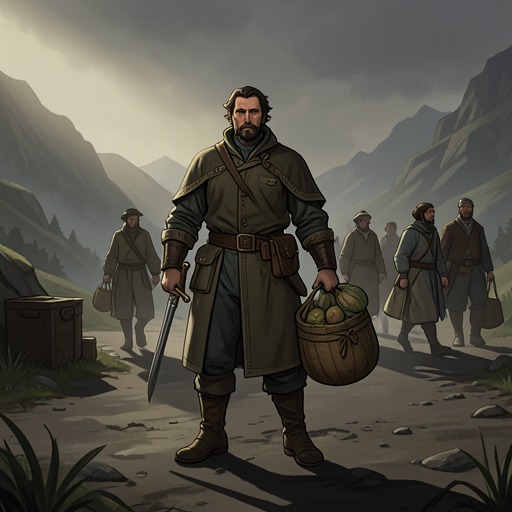
Eleanor Steals the Heart-Fruit
Chasing SunlightEleanor Steals the Heart-Fruit is the expedition’s sharpest rupture between necessity and trust. As the Endeavor enters the Arch of Khokorron, the passage demands a toll that can be paid only once: either the knowledge-bearing fruit taken from the Black Garden or a life. Jonathan Heights expects to use the fruit, but discovers that it is missing. His immediate conclusion is that Eleanor McAvey has taken it, turning a shared survival plan into a struggle over possession, knowledge, and life itself.
The Toll of the Arch
The confrontation begins when the Endeavor crosses into the Arch of Khokorron. Its former machinery opens into a vast tunnel lined with burning-lights, and the red illumination produces a sensation of knowledge arriving at the instant ignorance disappears. Jonathan understands that this transformation is not free: the Arch removes the very moment of learning as payment, and the toll cannot be paid twice. The fruit is therefore not merely food or treasure. It is a singular reserve of life and secret knowledge, intended to answer a condition of passage that would otherwise require a human life.
Jonathan’s confidence collapses when he reaches into his pocket and finds that the fruit is gone. A glimpse of Eleanor McAvey’s greatcoat shows her retreating toward her room, and he pursues her without pausing to determine whether temptation, resentment, or another motive has driven her. The missing fruit changes the expedition’s moral geometry: Eleanor is no longer simply a companion carrying dangerous knowledge, while Jonathan is no longer merely the expedition leader protecting a shared resource. Each becomes an immediate obstacle to the other’s survival.
Eleanor’s Attempt
Jonathan tears the door from its hinges and finds Eleanor McAvey concealed inside. Her hand grips the fruit, already raised toward her mouth, and she struggles to bite it before he can intervene. He seizes her by the throat and forces her against the wall, then pries her fingers away from the fruit as she strains forward to consume it. The scene makes the conflict bodily before either character can justify it in language: Eleanor’s grasp, Jonathan’s grip, and the fruit’s proximity to her teeth reduce the question of ownership to a contest over who can act first.
Jonathan takes the fruit and bites into it repeatedly, swallowing it before anyone can stop him. He experiences it as a complete life rather than as mere nourishment, a concentrated vitality that gathers within him and is immediately removed by the Arch’s red light. The fruit’s power is therefore spent almost as soon as it is obtained. Because its secrets are inseparable from the Black Garden, Jonathan cannot know what it would have done to a human being lacking the proper knowledge; the Arch takes both its meaning and its force before they can be fully realized, leaving only the taste of blood on his lips.
Antomine’s Intervention
The struggle ends only when Antomine commands Jonathan Heights to release Eleanor McAvey. Jonathan has continued holding her by the throat after taking the fruit, and he drops her when Antomine intervenes. Eleanor falls choking and gasping, while Antomine is joined by Sarah and Marie, who draw their daggers and stand ready in the cramped cabin. Sarah examines Eleanor and helps her to her bed, finding that although she is badly shaken and uncomfortable, she is not dying. Jonathan’s restraint has prevented a fatal injury, but the fact that he must be restrained at all marks the collapse of his former regard for Eleanor as a friend.
Claims of Necessity and Possession
Once Eleanor McAvey is on the bed, Jonathan Heights does not present the struggle as an assault. He argues that he was retrieving what belonged to him and was required to survive the journey, treating possession and necessity as if they settled the moral question. The claim is sharply undermined by the blood on his teeth. Antomine observes that Eleanor’s extremity was one Jonathan had brought upon himself and rejects his protestations of innocence, turning the scene from a dispute over an object into an accusation about the violence used to obtain it. Jonathan wipes his mouth with a handkerchief, finds it dark crimson, folds the stained cloth, and remains unmoved by the judgment directed at him.
Consequences for the Expedition
The immediate consequence is not only Eleanor McAvey’s injury but the hardening of the expedition’s internal hierarchy. Antomine produces a pistol and orders Sarah to check Eleanor, making clear that Jonathan Heights will not be allowed to decide unilaterally whether violence has ended. Jonathan, meanwhile, insists that he is needed on the bridge and challenges the others to hold him, instinctively reaching for the cane he no longer carries. The fruit has been consumed, the Arch’s toll has been paid, and the practical crisis continues; yet the group must now proceed with the knowledge that its leader has treated a companion’s body as an obstacle to be overcome. The scene converts a shared eastward venture into a guarded arrangement in which Antomine’s authority rests less on ordinary political power than on his willingness to point a weapon at Jonathan.
Wider Significance of the Seizure
The seizure also exposes how completely the expedition’s economy has been organized around exceptional materials and their unequal control. Before the Arch of Khokorron, Jonathan Heights had treated the heart-fruit as one item among the resources required for an eastern passage, alongside the Endeavor’s provisions, equipment, metals, and specialized substances. He had arranged supplies through Danby’s Point, loaded the ship with filters, searchlights, weapons, food, water, spare parts, clothing, and raw materials, and repeatedly converted objects into practical leverage: steel for barter, gold for labor and morale, and expeditionary cargo for movement through regions where ordinary commerce could not be trusted. The heart-fruit belongs to a different order. It cannot be replaced by money, divided among crew, or acquired again after use; its value lies in its singular capacity to satisfy a toll otherwise paid with a life. Eleanor McAvey’s attempt to consume it therefore transforms the expedition’s resource politics into an intimate struggle, while Jonathan Heights’s response reveals the cost of a leadership committed to reaching sunlight at any price.
The episode also clarifies the distance Jonathan Heights has traveled from the man who once regarded Eleanor McAvey as a useful ally and friend. He does not kill her, and the narrative gives his restraint a concrete limit: he has held back out of regard for her past assistance and possible future usefulness. Yet that qualification is itself revealing, because affection has become only one consideration among survival, possession, and the eastward objective. He recognizes that the part of him which regards her as a friend has grown faint as sunlight draws nearer, even while he insists that his goal belongs to the light rather than to the darkness associated with Ukari. The distinction does not absolve him. It instead produces the scene’s central contradiction: Jonathan claims to pursue a purifying revelation, but reaches it through blood, coercion, and the instrumental treatment of another person.
After the passage, the consequences extend beyond the cramped cabin. Antomine’s pistol and the maids’ drawn daggers establish a visible counterforce to Jonathan Heights’s authority, while Sarah’s examination confirms that Eleanor McAvey survives and permits the expedition to continue. Jonathan nevertheless makes clear that any further obstruction could provoke a more extreme response; his conflict with Antomine is no longer merely supervisory or political, since he contemplates destroying the inquisitor if he truly blocks the route. The heart-fruit is gone, the Arch has taken its life-force and knowledge, and the group has crossed a threshold from which its previous trust cannot simply be recovered.
In retrospect, the seizure foreshadows the expedition’s return in a battered Endeavor carrying an immense quantity of gold, with Antomine and the three women disembarking among the passengers. The western world remembers the voyage chiefly through its wealth and oddity, while the violence surrounding the heart-fruit remains part of the private cost of that windfall. The fruit’s consumption enables passage but does not produce a shared revelation: it leaves Jonathan Heights marked by blood, Eleanor McAvey injured and distrusted, Antomine armed, and the expedition materially enriched yet morally diminished. The action’s decisive significance lies in that exchange. A life is spared only because another person is violently dispossessed, and the promised journey toward light advances by making its travelers less capable of ordinary human attachment.